Venetian blinds — timber for character, aluminium for the lagoon air
Horizontal slats that tilt to steer light — full view, filtered light or full privacy at any height, on the same blind. The choice between timber and aluminium usually comes down to which part of Knysna the window is in.
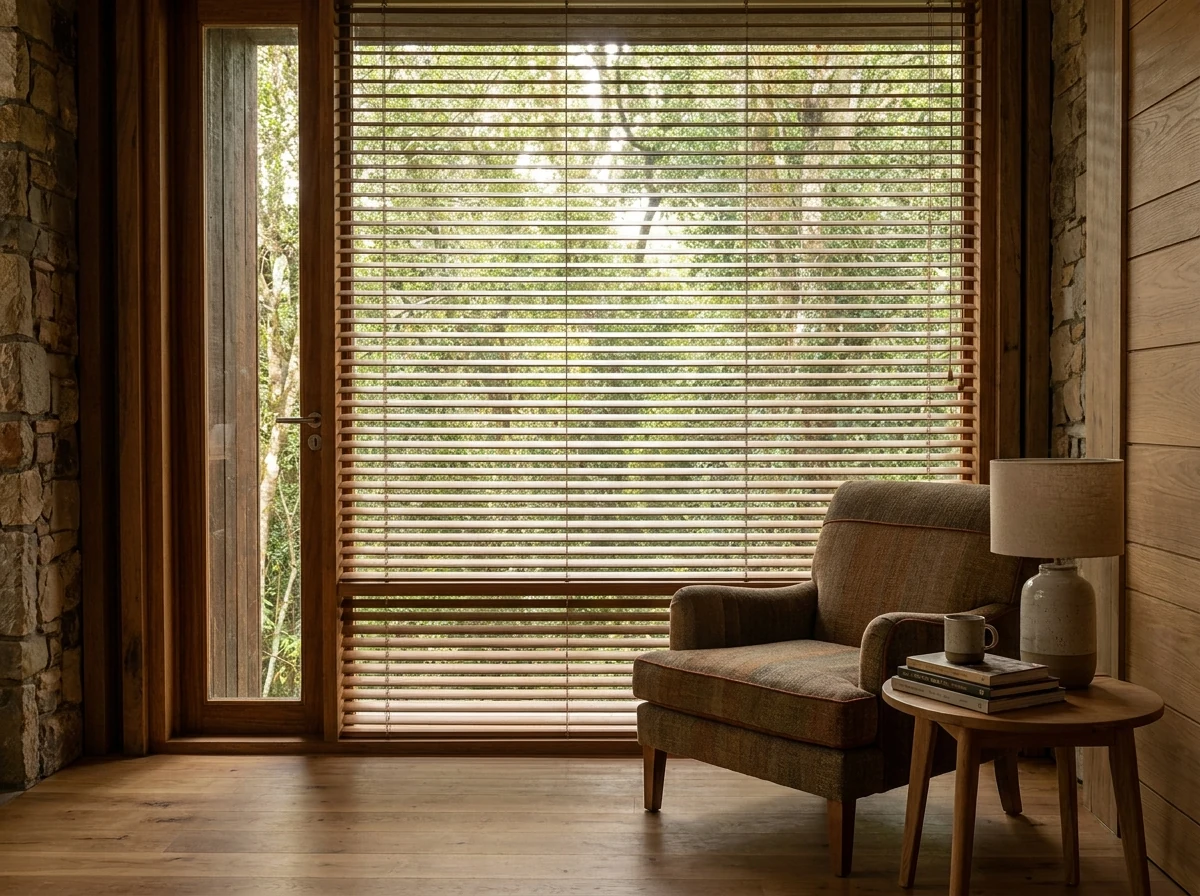
One blind, four different rooms
A roller blind is open or closed by degrees; a venetian steers light by direction. Tilt the slats up for glare-free daylight, down for privacy from a neighbour's upper storey, or closed flat for dark — all without raising or lowering the blind itself. On a Knysna window with hour-by-hour light changes, from misty morning to hard afternoon glare off the water, that adjustability does more work than a fixed fabric ever could.
Timber, for the rooms that want warmthThe natural choice for a heritage window
50mm basswood or bamboo slats bring real wood grain and warmth into a room — the obvious fit for Belvidere's Georgian and Victorian-revival cottages, sash windows, studies and anywhere the architecture is doing real work. Timber wants to stay out of high-steam rooms, but a proper lacquer finish handles Knysna's normal, year-round humidity without trouble. On a very wide window, timber's extra weight usually means splitting the blind or adding ladder-tape support rather than running one oversized span.
Aluminium, for the rooms the lagoon reaches firstThe moisture champion
25mm slats (the crisp, most popular width) or 50mm (bolder, fewer lines) in powder-coated aluminium shrug off humidity in a way fabric and timber can't — the honest first recommendation for kitchens, bathrooms, sculleries and any room where lagoon-driven damp is a daily fact rather than an occasional one. Near open water, powder-coated aluminium also handles salt air far better than raw metal, though an occasional rinse-wipe still matters at a genuinely exposed address like Brenton-on-Sea. The colour range runs wide, including wood-look finishes for anyone who wants the aluminium performance with something closer to a timber look.
Choosing between themA simple rule of thumb
If the room is a bathroom, kitchen, laundry, or sits directly on the open coast — aluminium. If the room is a heritage cottage, a study, or anywhere "real material" is part of the point — timber, with a proper lacquer finish. Most Knysna homes end up running both, room by room, and that's the honest answer more often than a single house-wide choice.
Venetian pricing, as a guide
Most of the price rides on the slat. As a guide per square metre installed, 25mm or 50mm aluminium works out at R1,000 to R1,500 on a wand or cord and R2,500 to R3,600 motorised, while hand-finished timber, wider and heavier, works out at R1,600 to R2,600 hand-operated and R3,000 to R4,500 with a motor.
In a damp coastal town that decision is practical before it is decorative. Aluminium handles a steamy bathroom and salt-laden air; timber, over a few seasons, does not. Deciding correctly at the measure is cheaper than replacing a blind afterwards. Anything below roughly a square metre attracts a minimum, since the headrail, the tilt gear and the tapes do not shrink with the pane. Confirmation comes in writing, window by window.
Other ways to treat the same window
Not sure which material suits your room?
A free in-home measure settles it, window by window.
Book a free in-home measure