Open water hands your lounge a second helping of the same sun. Forest hands the room next door almost none of it. This is the five-question conversation we actually have at a Knysna measure — written out in full so you can have most of it before we arrive.
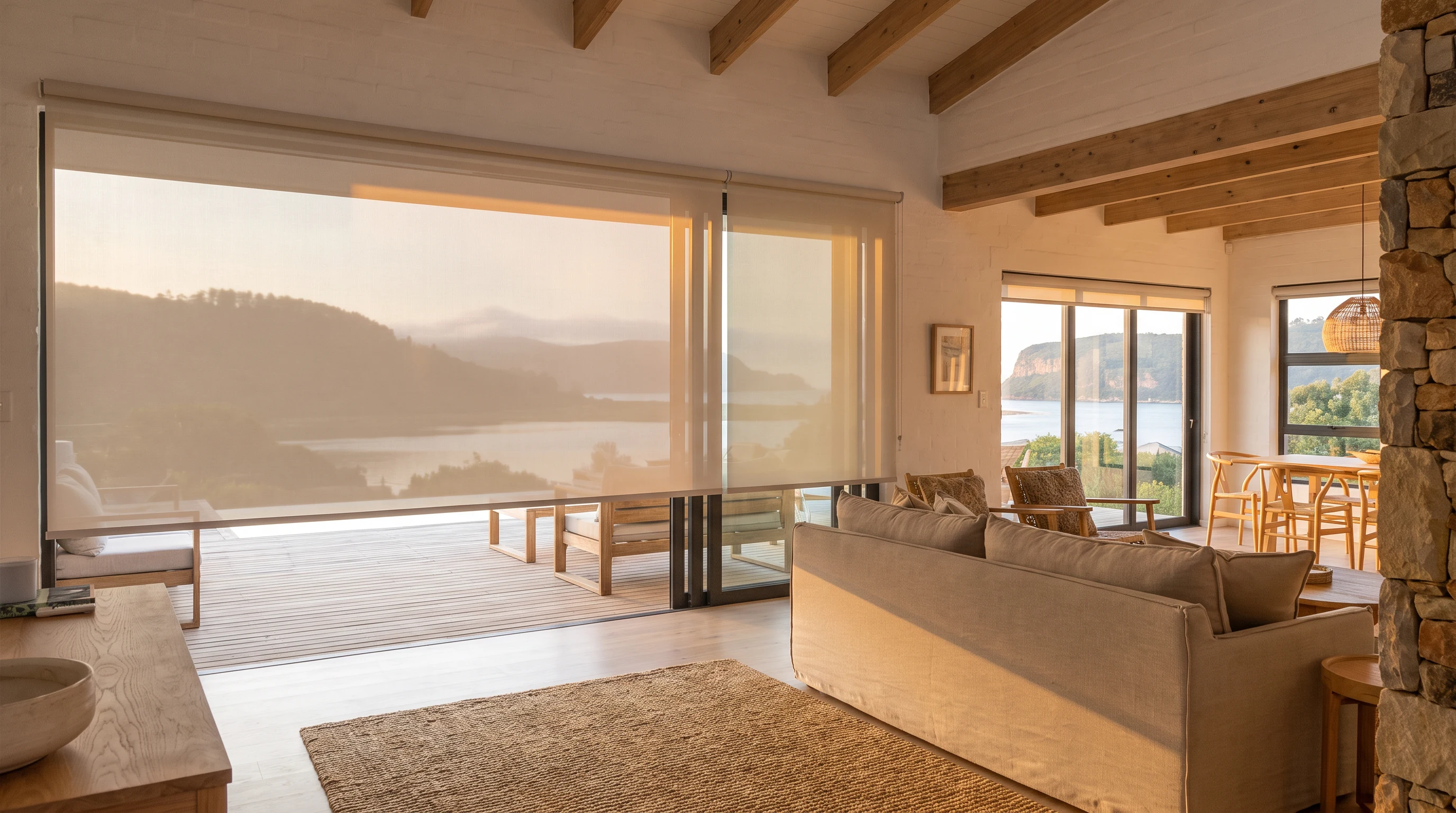
Late afternoon over the estuary: the mesh is doing the work, and the Heads are still in the room.
Greater Knysna is not one climate with one answer. It is an estuary town wrapped in the largest continuous indigenous forest in the country1 and opening, past the Heads, onto raw ocean. Three edges, three briefs. Everything below is sourced, and the list is at the foot of the page.
01Question one
Which water are you facing, and how far away is it?
Knysna's rainfall is spread fairly evenly across the whole year rather than gathered into one wet season, with roughly 750 to 900 mm falling annually and the heavier months tending to sit between May and August.2 But the first thing we ask about is not rain. It is which body of water your main glazing looks at, because water is a mirror and a mirror doubles your sun.
A lagoon-facing lounge on Thesen Islands or Leisure Isle takes the direct beam and then takes its reflection off the estuary surface, often for hours either side of noon. The room reads as brighter than the compass says it should be. On the far side of the Heads at Brenton-on-Sea, the reflecting surface is open ocean, the light is harder, and there is salt travelling with it.
Distance matters as much as direction. A house set back three streets from the water gets the glare without much of the salt; a canal-front or dune-front facade gets both, all the time.
What we'd do about it
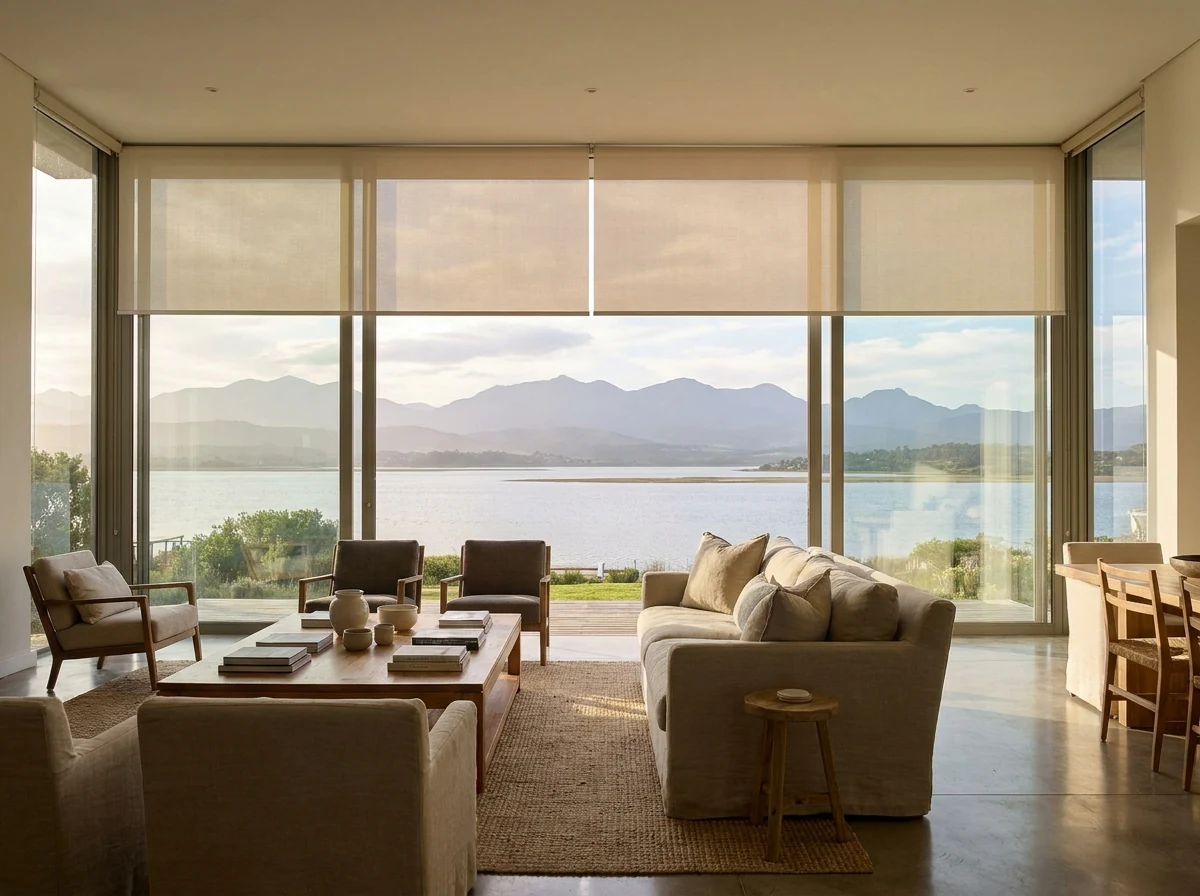
On estuary-facing glass, start with an open-weave sunscreen mesh rather than blockout — it takes the sting and the ultraviolet out while the water stays legible through it. On the ocean side, move the shading outside the glass with external venetian blinds or a roller shutter, so the pane never heats in the first place. Keep blockout for bedrooms, where you actually want the view switched off.
A third of the way down is often all a lagoon room needs. The water keeps its place in the picture.
02Question two
How much canopy is between you and the sky?
Turn a Knysna house around and the problem inverts completely. The indigenous forest here is the single largest block of Afromontane forest in South Africa — roughly 45,000 hectares running from Mossel Bay east to Harkerville, most of it now inside the Garden Route National Park — and a house on its edge sits under a canopy of yellowwood, stinkwood and ironwood that has already filtered the light before it reaches the window.1
A forest-facing room rarely has a heat problem. It has a dappled problem: moving patches of bright and dark that make a desk hard to work at and a television hard to watch, plus a room that can feel gloomy on an overcast morning and then be striped with hard light an hour later.
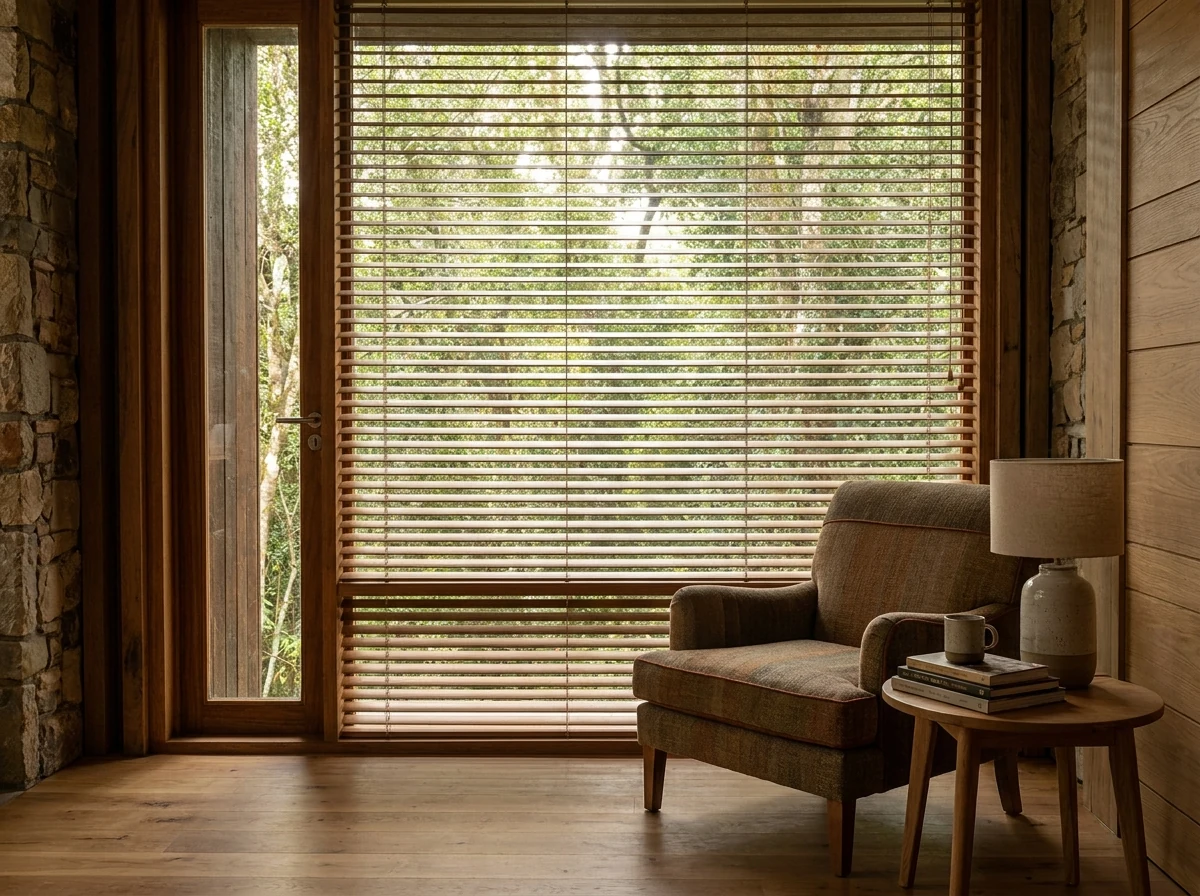
That asks for adjustment rather than blocking. Wide timber slats set to a shallow tilt bounce light off the ceiling and even the room out; the same slats closed give privacy without a heavy fabric. Where the room doubles as a bedroom, banded day-and-night fabric slides between sheer and solid on a single roller.
The honest limit
Timber slats want the drier, better-ventilated rooms. Under a wet canopy, a bathroom or a kitchen will treat real wood badly over a decade, and we would fit powder-coated aluminium slats there instead and keep the timber for the study and the bedrooms.
Under the canopy the job is evening the light out, not shutting it down.
03Question three
What is the house made of, and what is it allowed to look like?
Greater Knysna carries four or five building traditions inside twenty minutes' drive, and the material of the wall changes the mounting job as much as the aspect changes the fabric.
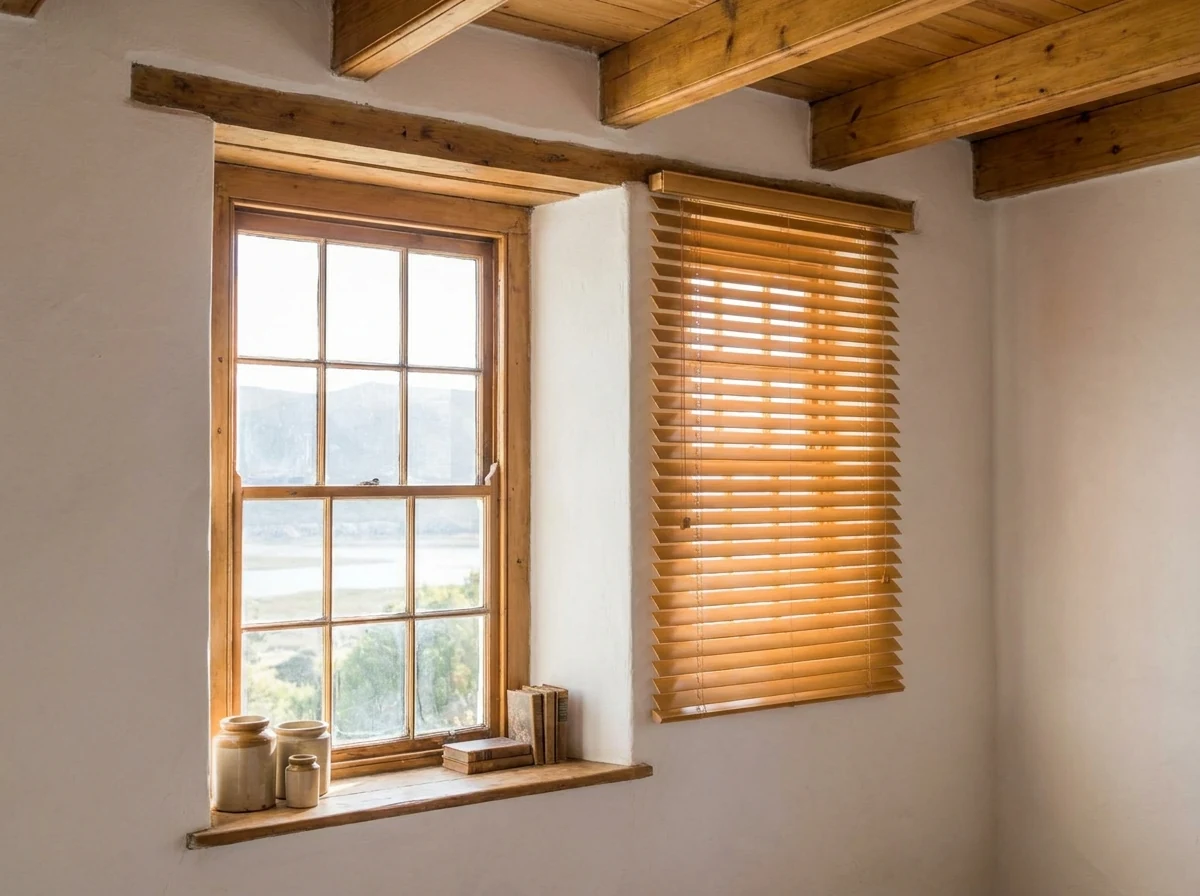
Belvidere. The hamlet grew around Thomas Henry Duthie's estate from the 1830s, and its small Norman-style church — designed by Sophia Gray, foundation stone laid in 1851, consecrated in 1855 — set the tone for everything built around it.3 Owners here generally want the outside of the building left alone. That is a brief we like: interior-first treatments, warm timber slats inside a deep sash reveal, nothing new bolted to a facade.
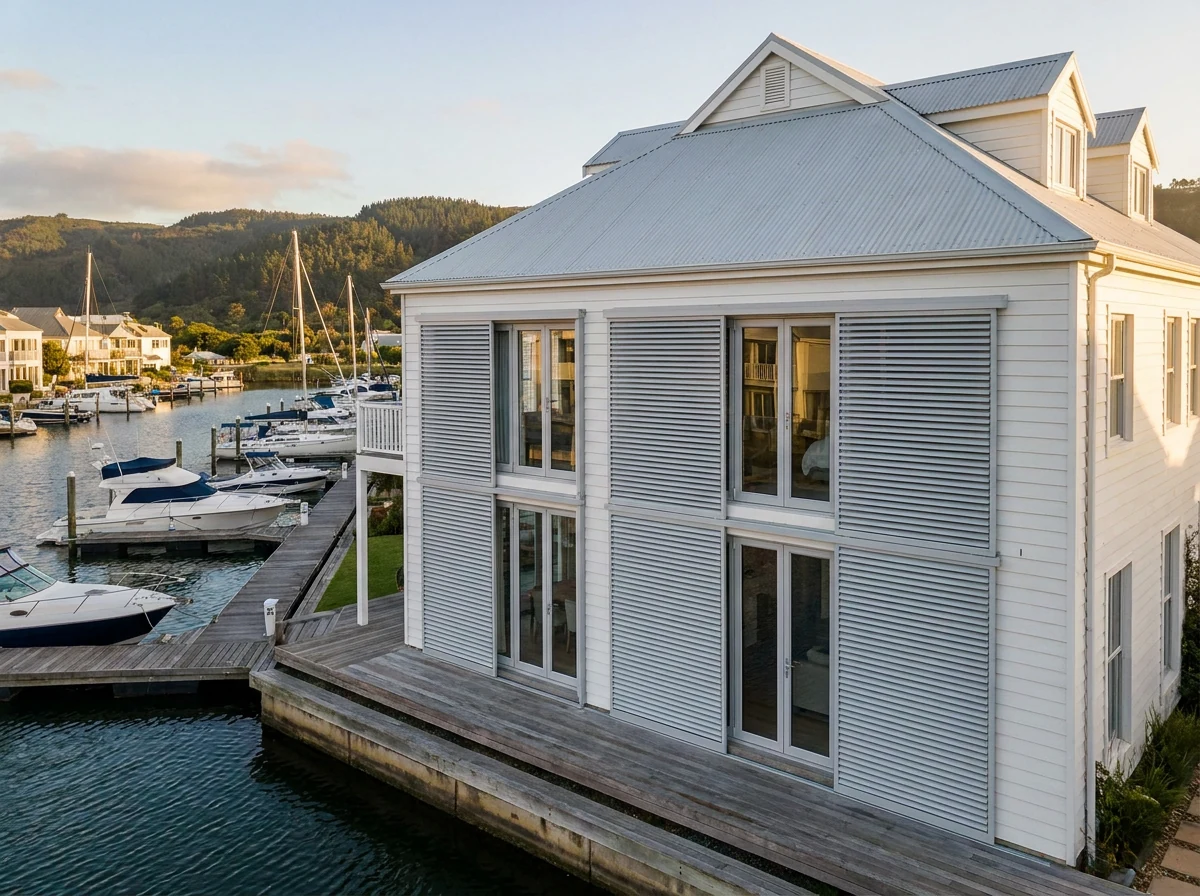
Thesen Islands. A coordinated colonial-maritime language, canal frontages, and tall glazed doors onto the water. Anything exterior here has to look deliberate rather than added, and a body corporate will usually want to see what it is before it goes up.
Timber-framed forest homes. Beautiful, and a genuinely different fixing exercise from masonry. Headrails and exterior cassettes need to land on structure, not cladding, which is a decision made with a stud finder at the window and not in an email.
Newer builds. Wide stacking doors and double-volume gable glass, often left bare because a standard blind was never designed for the span. Vertical and panel systems cover a whole run in one; guided or motorised systems handle the raked glass above.
What we won't do
We will not put a fixing into an older facade because it is the quickest route to a result. If a heritage-minded elevation or a body corporate rules out an exterior product, we will say so, price the best interior answer instead, and tell you plainly what performance you lose by staying inside the glass.
Belvidere: everything happens inside the reveal, and the cottage keeps its face.
04Question four
What does this air do to metal?
This is the question most quotes skip, and it is the one that decides whether you are doing this again in six years. Knysna's average relative humidity runs high year-round, and the town does not get the long dry spell that lets a house and its fittings bake out.2 Add salt on the ocean side and you have a slow, constant attack on brackets, chains, screws and motor housings — never on the fabric first.
So our specification order is deliberately backwards from most: hardware, then fabric, then colour.
Powder-coated aluminium components and stainless fixings as the default anywhere the sea air reaches, which on a Brenton or canal-front address is everywhere.
Sealed cassettes on exterior systems, so the tube and the motor are not parked in wet air through a nine-month damp season.
Solution-dyed and coated fabrics, where colour is in the fibre rather than on it, because printed cloth fades and chalks fastest exactly where the light is strongest.
Zip-track screens rather than loose-hanging outdoor blinds on any exposed deck: mesh locked into side channels holds shape in wind instead of working its own fixings loose.
And where we'd spend less
Inside the estuary, on Thesen Islands or Leisure Isle, the surrounding land gives real shelter. A house tucked there often does not need the full marine specification a Brenton-on-Sea beach house does, and we would rather tell you that at the measure than sell you the heavier system twice over.
Thesen Islands canal frontage: powder-coated slats outside the glass, sitting flush enough to read as part of the building.
05Question five
Who is actually in the house in July?
A fair share of Knysna's stock is used seasonally, and a house that stands closed through the wettest, coolest months has different needs from one lived in daily. Shut up, unheated and unventilated, a room holds moisture, and the first thing that suffers is anything organic — timber, untreated cloth, linings.
Two practical answers, neither of them exotic:
Cellular honeycomb blinds trap a layer of still air against the pane and take the edge off a cold, damp room without a heater running. They are the right call for a nursery, a north-lit bedroom or a room over a garage.
Motorised control on a schedule means the blinds keep moving while nobody is home, so one elevation is not left under full sun in the same position for eight weeks. It is a fabric-longevity argument as much as a comfort one.
Said plainly
A blind is not a dehumidifier. If condensation runs down the inside of your glass, the fix is ventilation and heating; a cellular blind helps at the margin and nothing more. We would rather lose that sale than have you believe otherwise.
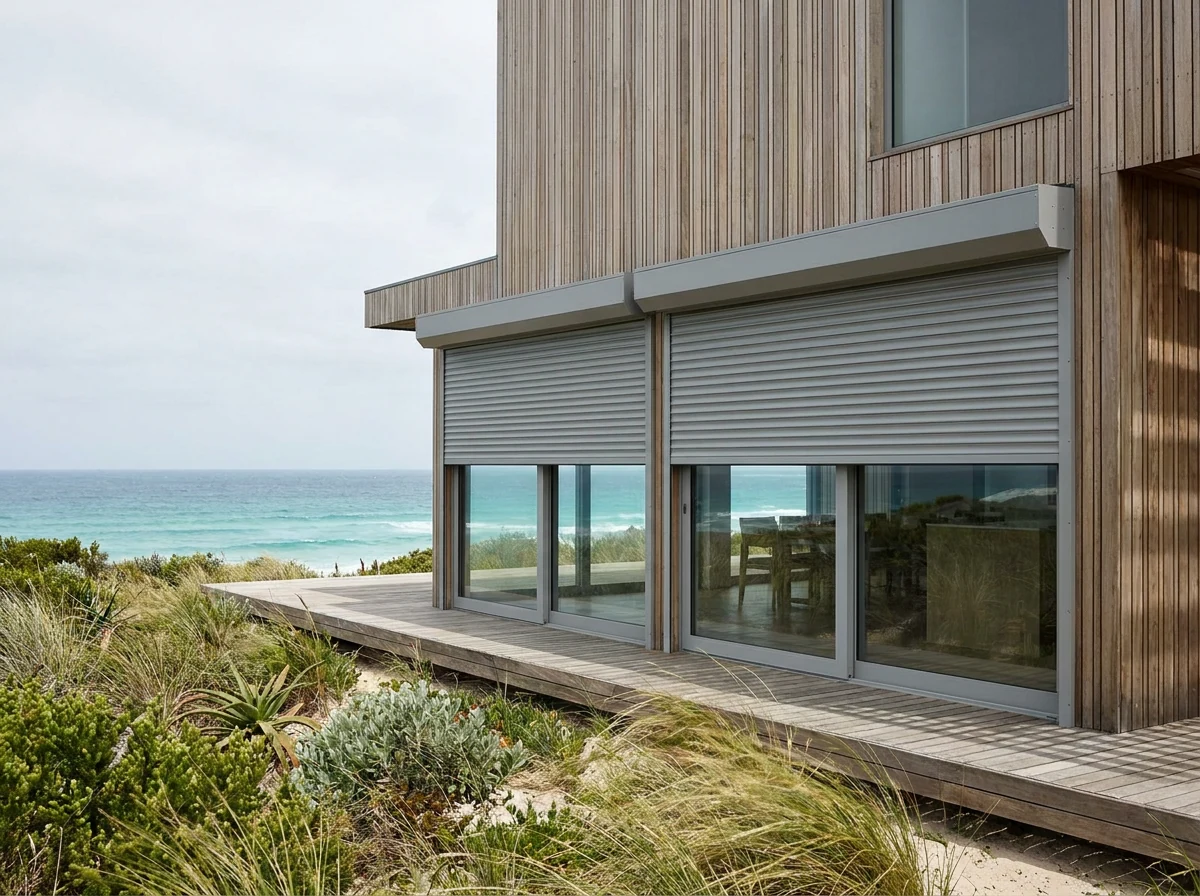
Brenton-on-Sea: shutters on the outside of the glass, closed against the sun. Shading, not security.
—Afterwards
A plain word about fire, because you will be thinking it
In June 2017 fire moved through this district and, on the Knysna municipality's own damage register, more than a thousand houses were destroyed and hundreds more damaged.4 Nobody who lives here needs that explained. It does come up at measures, so we will be straight about it.
Aluminium slats, aluminium roller shutters and aluminium headboxes are non-combustible materials, and a closed external shutter puts a metal layer between a pane of glass and radiant heat. That is a genuine property of the material. It is not a fire rating, we do not test to one, and we will never sell you a shading product as fire protection. If wildfire resilience is your actual goal, the people to speak to are your local fire protection association and your insurer — the meaningful decisions are about vegetation clearance, roof detail and gutters, and they are made long before anyone talks about window coverings.
The one claim we will make
Everything we quote for the outside of a Knysna house is specified to survive the ordinary weather here: wind, wet air and salt. That is a durability promise, and it is the only one we make.
→Last thing
What none of this can settle from a distance
Reveal depth, true orientation, whether the deck is sheltered by the land or only looks like it, and whether an exterior fixing is going into structure or cladding — those four are decided at the window with a tape measure and a compass, not from a photograph. That is exactly what the free in-home measure is for: it costs nothing, it commits you to nothing, and it ends with a written quote per window rather than one number for the whole house.
The next step
Have the other half of this conversation at your window
Fill this in and one of our expert consultants will contact you shortly to arrange your free in-home measure anywhere in greater Knysna.
→
Answer question one for us
Tell us which water your main glass faces — estuary, canal or open ocean — and the consultant arrives already halfway to an answer.
→
Nobody prices a window they have not seen
The measure comes first, always. We do not put numbers on a phone call.
Everything above, checkable
Sources
SANParks — Garden Route National Park, forest excursions, and the Knysna–Amatole montane forest record: the largest continuous indigenous forest complex in South Africa, roughly 45,000 ha from Mossel Bay to Harkerville, largely incorporated into the park since 2009. sanparks.org — Garden Route forest excursions
Knysna Museums — Belvidere and the Duthie family, and the Holy Trinity Church record: built for Thomas Henry Duthie, designed by Sophia Gray, foundation stone laid 15 October 1851 and consecrated 5 October 1855. knysnamuseums.co.za — Belvidere and the Duthie family